How to Tell If a Dating Profile Photo Is AI-Generated (2026)
You match with someone on a dating app. Their photos look great — good lighting, natural smile, the kind of candid shots that feel authentic. But something nags at you. Maybe the skin looks a little too smooth, or the background seems slightly off.
In 2026, that instinct is worth listening to. AI-generated profile photos have become one of the fastest-growing tools for catfishing and romance scams. The technology is cheap, accessible, and increasingly convincing. According to the U.S. Federal Trade Commission, consumers reported $1.14 billion in romance scam losses in 2023 alone, with a median individual loss of $2,000 (FTC Consumer Sentinel Network Data Book, 2023). The FBI's Internet Crime Complaint Center (IC3) consistently ranks romance fraud among the top cybercrime categories by total dollar losses (FBI IC3 Annual Report, 2023).
The rise of AI image generators has made it trivially easy to create photorealistic profile photos that never belonged to a real person. Tools like ThisPersonDoesNotExist.com, powered by NVIDIA's StyleGAN2 architecture, can generate an unlimited supply of faces that look convincingly human — each one unique, each one fake (Karras et al., "Analyzing and Improving the Image Quality of StyleGAN," CVPR 2020).
Below, we walk through exactly how to spot AI-generated dating profile photos, what detection tools can do that your eyes can't, and how to protect yourself.
Why AI-Generated Dating Profiles Are a Growing Problem
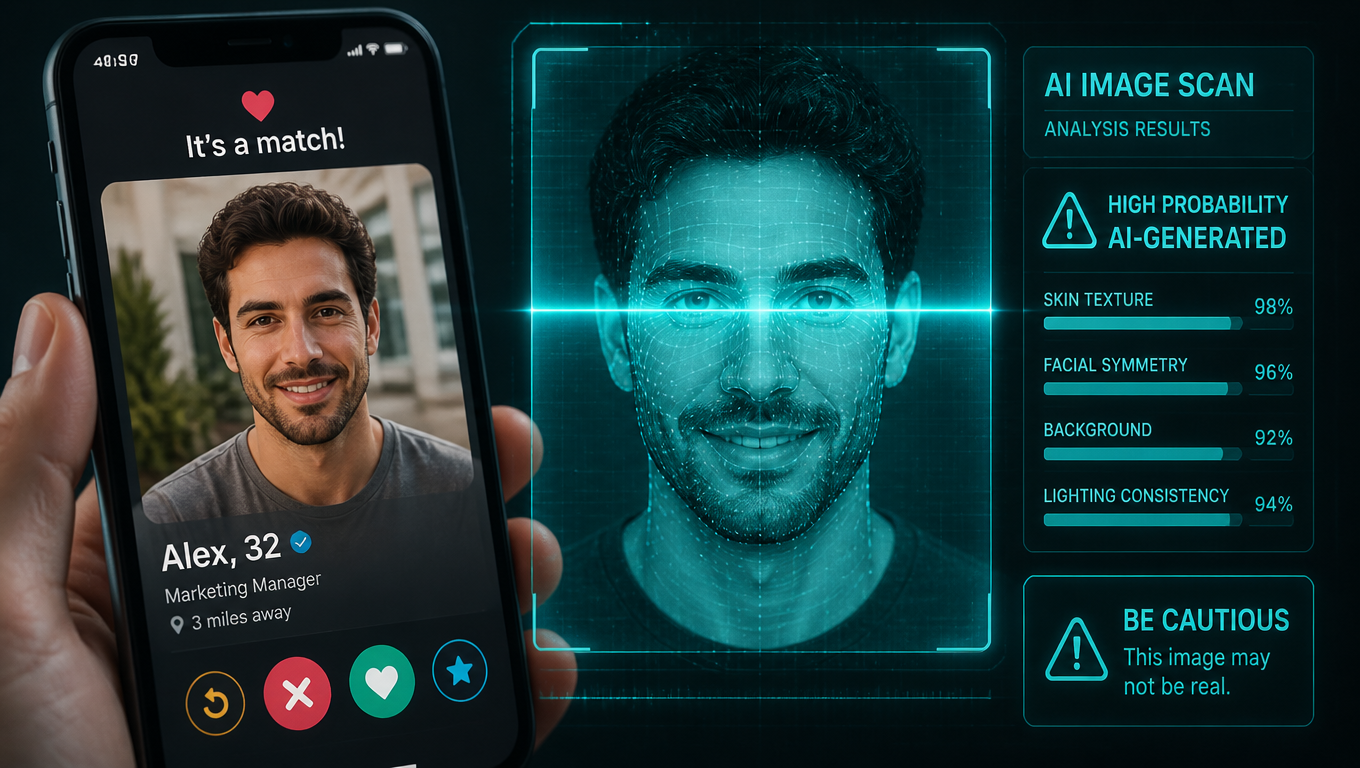
The economics are simple. Creating a fake dating profile used to require stealing someone else's photos — which meant reverse image search could catch it. Now, AI generates entirely new faces that have never existed, making traditional verification methods useless.
A 2023 study from Lancaster University found that AI-generated faces are now perceived as more realistic than actual human photographs. In controlled experiments, participants consistently rated AI faces as more "trustworthy" than real ones — meaning the very quality that makes a dating profile feel authentic (trustworthiness) is exactly what AI has learned to simulate (Tucci et al., "AI Hyperrealism: Why AI Faces Are Judged as More Real Than Human Ones," Proceedings of the National Academy of Sciences, 2023).
This creates a perfect storm for dating platforms:
- Tinder reported removing millions of fake profiles annually and has introduced AI-powered verification features, though enforcement remains a cat-and-mouse game.
- Bumble introduced mandatory photo verification using real-time selfie matching, but this only catches simple copycat fakes — not AI-generated images.
- Hinge and other Match Group apps rely on user reporting and behavioral signals rather than image-level detection.
The gap between what platforms can catch and what scammers can produce is widening.
5 Signs a Dating Profile Photo Might Be AI-Generated
AI image generators have improved dramatically, but they still leave forensic traces. Here's what to look for — ranked from easiest to hardest to spot:
1. Eyes: The Most Reliable Tell
Zoom into the eyes. In a real photo, the reflections in both eyes come from the same light source — same shape, same position, same brightness. AI-generated eyes often have mismatched reflections: one eye might show a window reflection while the other shows a lamp, or the shapes differ between left and right.
Also check the pupils. Real pupils are rarely perfectly circular and identical in size. AI-generated pupils tend to be unnaturally symmetrical.
For a deeper breakdown of how facial geometry analysis works, read: How to Detect AI-Generated Images: 5 Checks Anyone Can Do.
2. Hands, Fingers, and Accessories
If the profile photo shows hands — holding a drink, touching their face, resting on a table — count the fingers. Check if rings sit at plausible positions relative to knuckles. AI still struggles with complex hand poses, especially when fingers overlap or grip objects.
Look at earrings, necklaces, and glasses. AI frequently generates jewelry that doesn't match between sides or has physically impossible connections.
3. Skin and Hair Texture
Real skin has pores, blemishes, and uneven texture. AI-generated skin tends to be overly smooth — almost airbrushed — especially around the cheeks and forehead. At high zoom, real hair shows individual strands with natural variation. AI hair often blends into an unnatural uniformity, particularly where hair meets the forehead or ears.
4. Background Inconsistencies
Scan the edges of the frame. AI-generated backgrounds often contain subtle impossibilities: architectural details that don't connect, railings that merge into walls, text on signs that's garbled or doesn't spell anything, or surfaces that shift texture mid-object.
Dating profile photos are often taken in recognizable settings (cafés, parks, city streets). If the background feels vaguely generic or has oddly repeating patterns, it's worth a closer look.
5. The "Too Perfect" Overall Feel
This is the hardest tell to articulate but often the first thing that triggers your gut feeling. Real candid photos have imperfections — slight motion blur, uneven lighting, sensor noise. AI-generated photos often have a cinematic smoothness that feels more like a movie still than a phone snapshot.
If every photo in a profile looks like it was taken by a professional photographer with perfect lighting, but the bio claims they're just a regular person — that disconnect is a signal.
Quick check: Drop any suspicious profile photo into our free AI image detector — it catches AI artifacts at the pixel level, including patterns invisible to the human eye. No signup, no data stored.
How AI Image Detection Tools Catch What Your Eyes Miss
Visual inspection works for obvious fakes, but modern AI generators are specifically trained to avoid the tells listed above. That's where algorithmic detection becomes essential.
At isthisaiphoto.com, we use a multi-engine fusion approach that analyzes images at three levels:
Frequency Domain Analysis (Fourier Transform)
Every image can be decomposed into frequency components. Real camera photos have a smooth, organic frequency distribution. AI-generated images show periodic patterns — repeating spikes in high-frequency bands — that come from the mathematical operations used during generation (upsampling, convolutions, noise scheduling). These patterns are invisible to the naked eye but statistically distinct.
Real Photo:     Smooth, organic frequency falloff
AI Generated:   Periodic spikes in high-frequency bands
This is one of the hardest artifacts for generators to eliminate because it's baked into the architecture itself.
Noise Pattern Analysis
Real phone cameras introduce sensor noise — tiny random variations that follow statistical distributions unique to the camera hardware. AI-generated images don't come from cameras, so they produce artificial noise patterns that are distinguishable by statistical analysis. Even when an AI image is blurred, compressed, or filtered, the underlying noise signature often persists.
Model Fingerprinting
Each AI architecture — GAN, diffusion model, transformer — leaves a unique signature in its output. Our detector can identify which model family generated an image, covering 60+ architectures including Midjourney, DALL-E 3, Stable Diffusion XL, Flux, and Google Gemini (Imagen). For a real-world demonstration of these methods, see: Can AI Detectors Catch OpenAI's Latest Images? We Tested It.
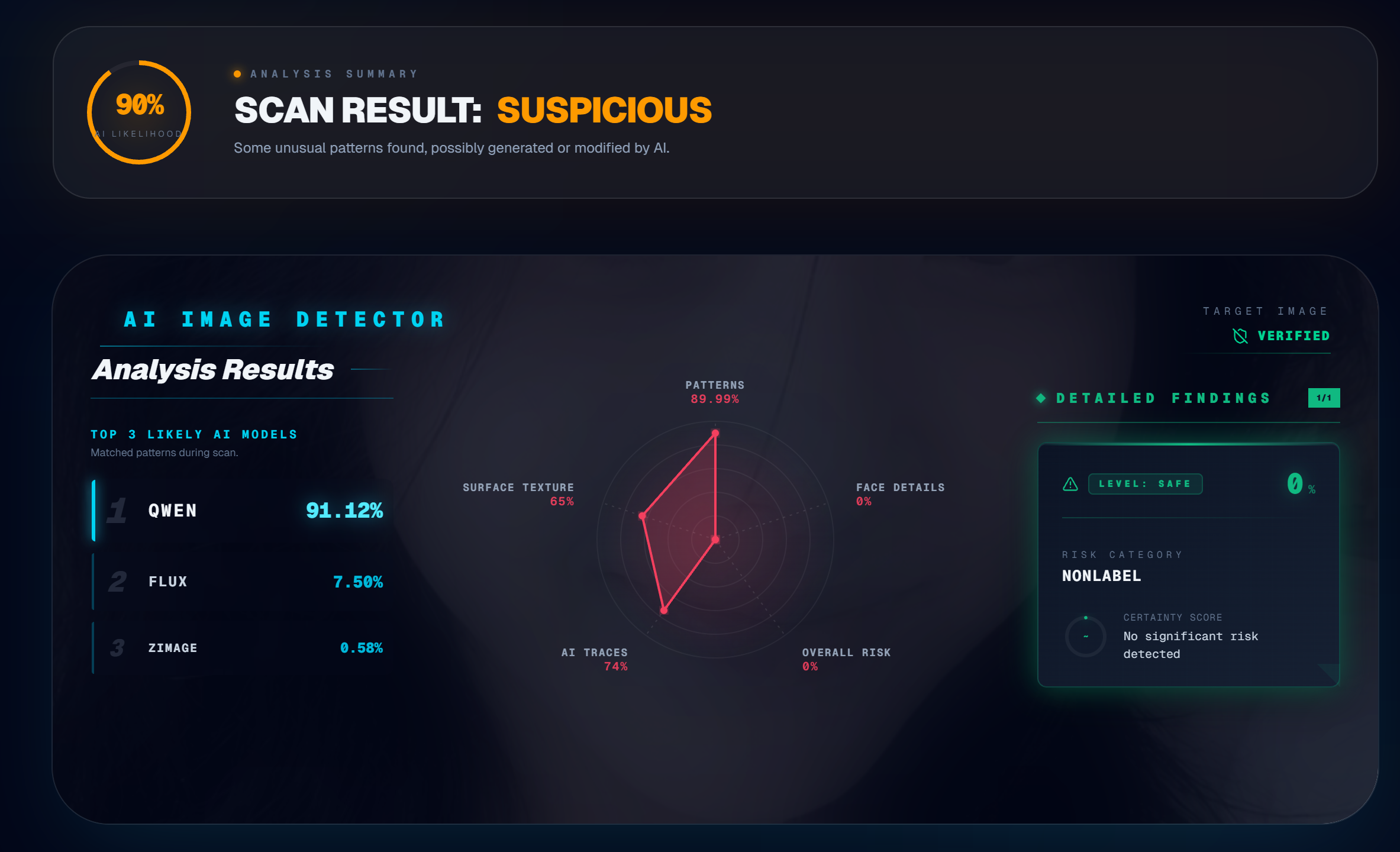
Try it free: Upload any dating profile photo at isthisaiphoto.com — you'll get a confidence score, a radar chart breakdown, and a detailed analysis showing exactly where the image looks suspicious. No account needed, no data stored.
How Deepfake Photos Are Used in Romance Scams
Understanding the scam playbook helps you recognize the pattern before you're emotionally invested:
The Standard Playbook
- Profile creation. Scammer uses AI-generated photos to create a convincing dating profile — often multiple photos showing the same "person" in different settings (this is now possible with consistent face generation).
- Emotional engagement. They build trust over days or weeks through conversation, often claiming to be working abroad (military, oil rig, international business).
- The ask. Once emotional attachment is established, requests begin — emergency expenses, investment opportunities (often crypto), or travel money to "come visit."
- Escalation. If the victim pays once, the requests continue. Each "emergency" is more urgent than the last.
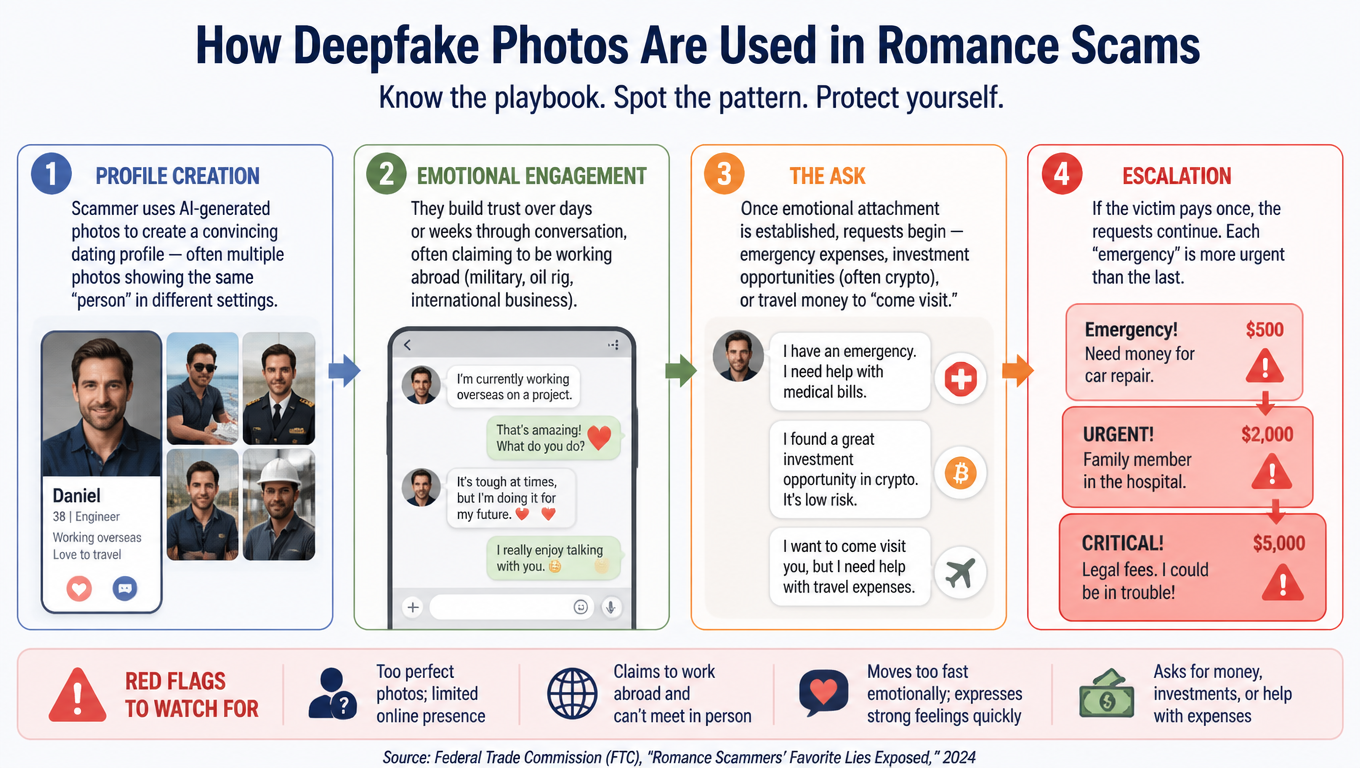
This pattern is well-documented in the FTC's romance scam reports (FTC, "Romance Scammers' Favorite Lies Exposed," 2024).
How AI Makes Scams More Convincing
- No reverse image search match. Unlike stolen photos, AI-generated faces don't appear anywhere else on the internet.
- Consistent identity. Newer generative models can produce multiple photos of the "same" fictional person in different poses and settings.
- Video deepfakes. Some scammers now use real-time face-swap tools (like DeepFaceLive) during video calls to maintain the illusion.
For a deeper look at how deepfakes are challenging identity verification systems, read: Can Deepfakes Fool Face ID? How AI Is Breaking Facial Recognition.
What to Do If You Suspect a Profile Is Fake
- Run the photos through a detector. Upload each photo to isthisaiphoto.com and check the confidence score. AI-generated photos typically score 80%+ on our analysis.
- Reverse image search. While AI-generated faces won't have matches, some scammers still use stolen photos. Use Google Images or TinEye to check.
- Request a live video call. Ask for a real-time video chat with specific actions (wave, touch their nose, show their surroundings). Simple video deepfakes struggle with spontaneous, specific requests.
- Watch for the pattern. If they claim to be abroad, refuse to meet in person, or start asking for money — it's almost certainly a scam regardless of whether the photos are AI-generated.
- Report the profile. Every major dating app has reporting mechanisms for fake profiles. Reporting helps the platform improve its detection systems.
Limitations of Visual Detection
No method is foolproof. Be aware of these constraints:
- Post-processing degrades signals. Screenshots, compression, and social media filters can strip the artifacts detectors rely on. Always use the highest-quality version of the image available.
- New models improve rapidly. When a new generator architecture launches, existing detectors may need updates to recognize its output.
- False positives exist. Heavily edited real photos — beauty filters, HDR processing, professional retouching — can sometimes trigger detection flags.
The most reliable approach combines automated detection with your own judgment. Use tools as a strong signal, not a final verdict.
Frequently Asked Questions
Can AI-generated dating profile photos fool reverse image search?
Yes. Unlike stolen photos, AI-generated faces are created from scratch and don't appear anywhere else on the internet. Traditional reverse image search (Google Images, TinEye) will find zero matches — which is itself a red flag. A new account with multiple polished photos and no web presence is suspicious. Use an AI image detector for a more definitive check.
How accurate are AI detectors at catching fake dating photos?
Multi-engine detectors like RealPix achieve 95%+ accuracy by combining frequency analysis, noise pattern analysis, and model fingerprinting. In our tests, AI-generated profile photos — including deliberately blurred and low-quality ones — consistently scored 80-90% on the suspicious rating. The detection works at the pixel and frequency level, so image quality and visual filters don't hide the underlying generation patterns.
What should I do if I've already sent money to someone with a fake profile?
Stop sending money immediately. Report the profile to the dating app and file a complaint with the FTC at reportfraud.ftc.gov and the FBI's IC3 at ic3.gov. If you sent money via wire transfer or gift cards, contact your bank or the gift card issuer immediately — in some cases, transactions can be reversed if reported quickly.
Do dating apps use AI to detect fake profiles?
Major dating apps are increasingly deploying AI-powered verification, but enforcement varies. Tinder introduced photo verification using real-time selfie matching. Bumble uses similar technology. However, these systems primarily catch simple photo theft — they're less effective against AI-generated images. The detection gap between what scammers can produce and what platforms can catch remains significant.
Spotted a suspicious dating profile? Check it in seconds — isthisaiphoto.com is free, private, and works on images from any AI model. No signup required.
Related Reading
- How to Detect AI-Generated Images: 5 Checks Anyone Can Do — A practical guide with visual checks and scenario-specific tips for any AI image.
- Can Deepfakes Fool Face ID? How AI Is Breaking Facial Recognition — How deepfakes are bypassing biometric authentication and what's being done about it.
- How to Spot AI-Generated Images: Artifacts, Detection Methods & Defenses — The research-backed deep dive into detection, disruption, and authentication methods.
References
- U.S. Federal Trade Commission. Consumer Sentinel Network Data Book 2023. FTC.gov, February 2024. — Reported $1.14 billion in romance scam losses with median individual loss of $2,000.
- FBI Internet Crime Complaint Center. IC3 Annual Report 2023. IC3.gov, 2024. — Romance fraud ranked among top cybercrime categories by total dollar losses.
- Tucci, S., et al. "AI Hyperrealism: Why AI Faces Are Judged as More Real Than Human Ones." Proceedings of the National Academy of Sciences (PNAS), 2023. — Lancaster University study finding AI-generated faces perceived as more trustworthy than real photographs.
- Karras, T., et al. "Analyzing and Improving the Image Quality of StyleGAN." Proceedings of the IEEE/CVF Conference on Computer Vision and Pattern Recognition (CVPR), 2020. — Foundation architecture for ThisPersonDoesNotExist and AI face generation.
- U.S. Federal Trade Commission. "Romance Scammers' Favorite Lies Exposed." FTC.gov, 2024. — Documented patterns in romance scam tactics and emotional manipulation.