Can Deepfakes Fool Face ID? How AI Is Breaking Facial Recognition (2026)
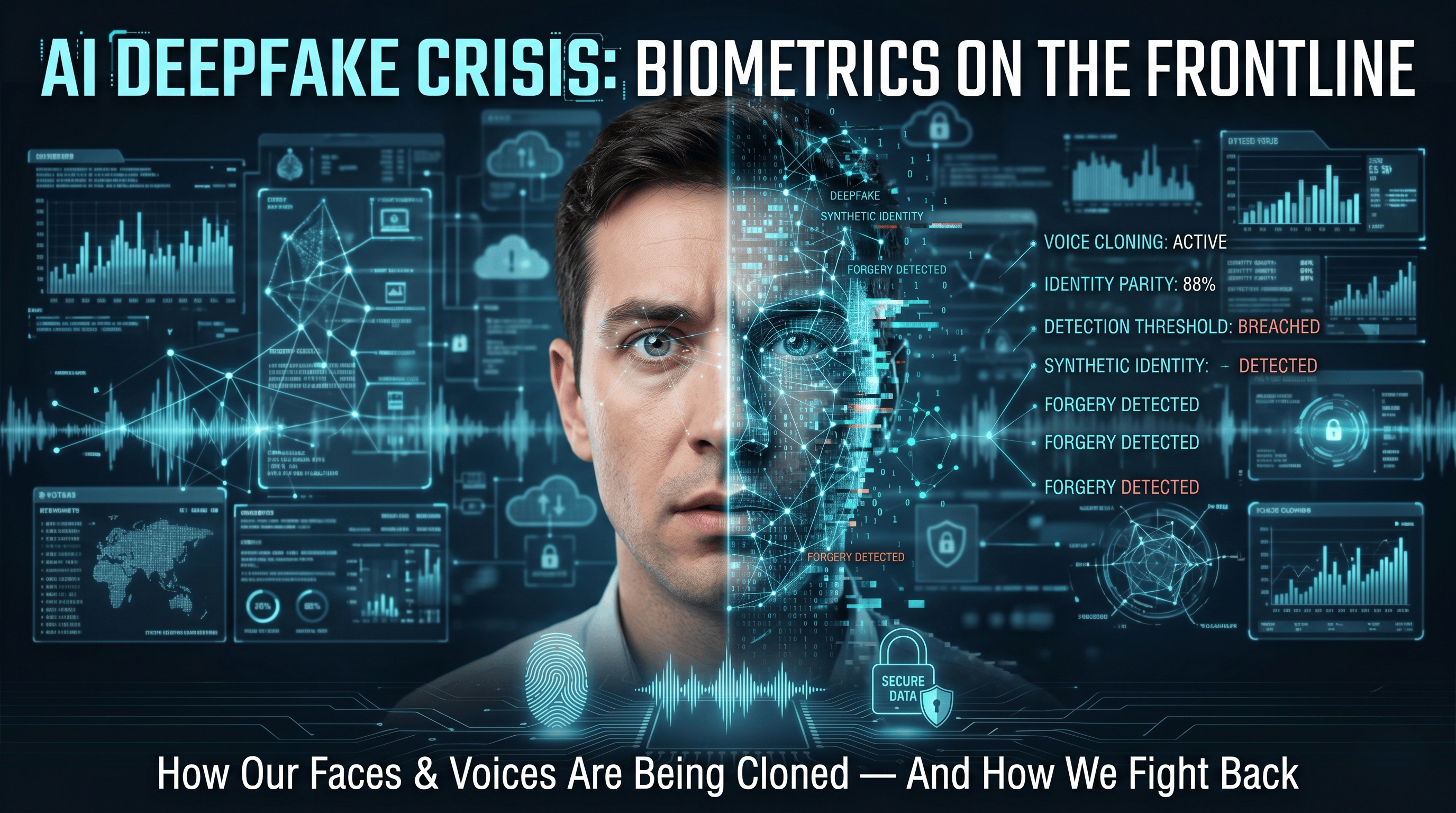
We unlock our phones with a glance and approve bank transfers with a fingerprint. It's so seamless that most people never question it — if banks and Apple trust face recognition, it must be secure.
That assumption is falling apart. A recent study surveyed 408 professionals and conducted in-depth interviews with 25 security experts and 12 members of the general public. The central finding: there's a dangerous gap between how safe people think biometrics are and how vulnerable experts know they are.
The researchers call it "outsourced trust" — users assume that because institutions endorse biometric login, the technology must be bulletproof. Meanwhile, the experts in the study are sounding alarms about specific attack vectors that most consumers have never heard of.
How Easy Is It to Make a Deepfake Now?
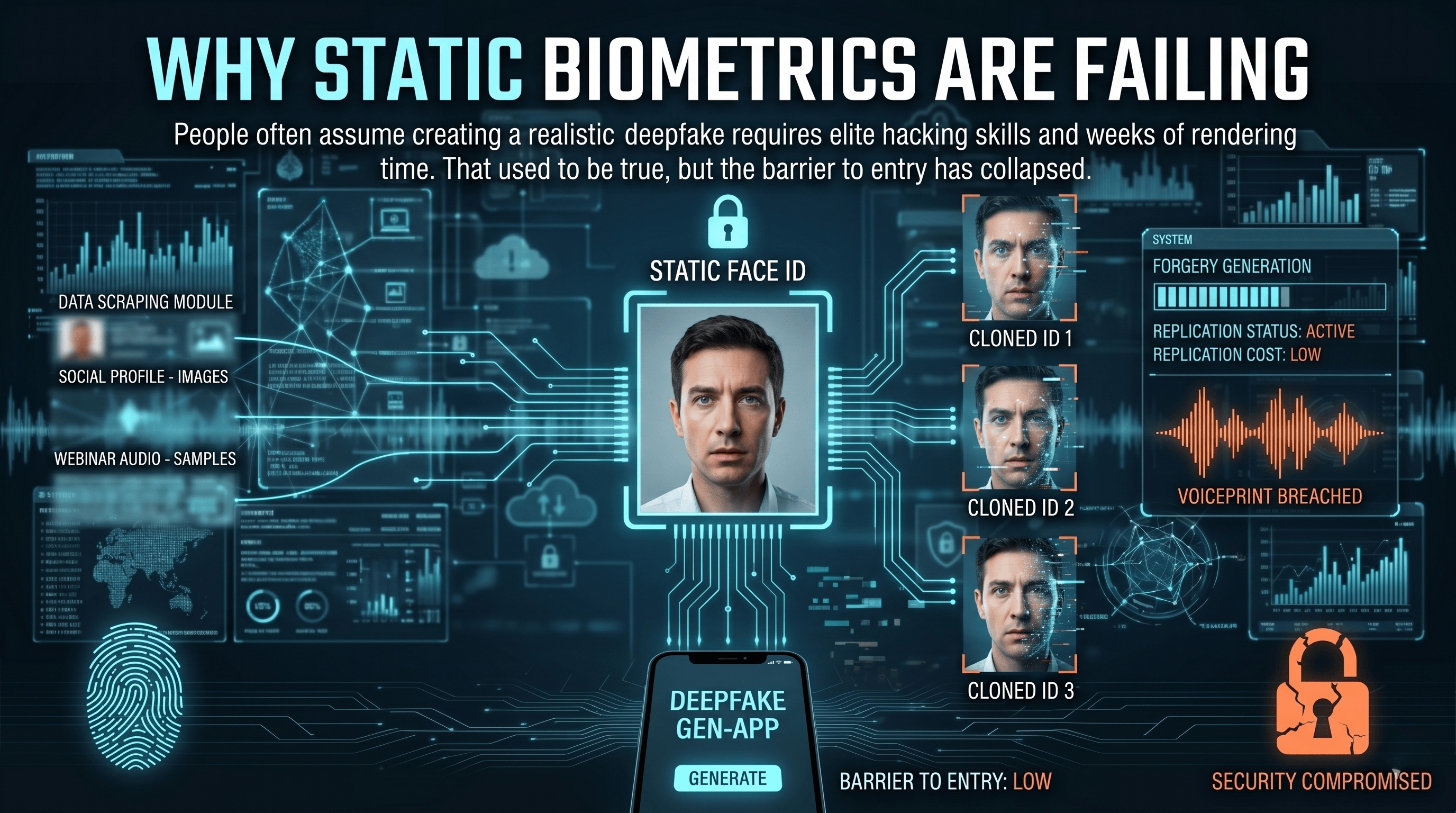
The barrier has collapsed. The study's expert participants described a world where creating a convincing identity deepfake no longer requires specialized hardware or weeks of rendering time. As one expert put it, "inexpensive cloud GPUs reduce training time from days to hours."
The raw material is already public. Your Instagram selfies, Zoom meeting recordings, a 30-second voice clip from a podcast — all of it is enough to train a generative model. Consumer-grade apps like DeepFaceLive and Wav2Lip now enable real-time face swapping during video calls, and SaaS platforms like D-ID let users generate synthetic talking-head videos with no technical expertise at all.
What used to be a state-level capability is now a consumer product. For a practical guide on spotting these fakes visually, see: How to Detect AI-Generated Images: 5 Checks Anyone Can Do.
The Three Types of Attacks on Biometric Systems
The study documents three distinct attack categories that experts are tracking:
1. Presentation Attacks
The most straightforward approach: showing a deepfaked video or image to a camera-based authentication system. Older systems without depth sensing — including many laptop webcams, security cameras, and basic smartphone face unlock implementations — can be fooled this way. The key limitation for attackers is that systems with 3D depth mapping (like Apple's Face ID with TrueDepth camera) are significantly harder to spoof.
2. Digital Injection Attacks
This is the one that keeps security researchers up at night. Instead of trying to fool a camera, attackers bypass the camera entirely — injecting synthetic video directly into the device's data stream. The authentication system never sees a real camera feed; it processes fabricated data that's been crafted to pass validation checks.
This attack vector is particularly dangerous because it sidesteps all physical-world defenses: lighting analysis, depth sensing, even liveness detection that checks for blinking or head movement. If the injected stream is convincing enough, the system has no physical-world reference point to compare against.
3. Voice Synthesis
Banks, call centers, and customer service lines increasingly use voice biometrics for phone-based authentication. Attackers can now clone a voice from a short audio sample and generate real-time synthetic speech that passes voiceprint matching. The study's experts noted this is being used in financial fraud and social engineering at increasing scale.
The £20 Million Test Case
This isn't theoretical. The study cites the Arup Hong Kong incident, where a British engineering firm lost £20 million after an employee was deceived by a deepfake video call impersonating company executives. The attackers harvested publicly available video of the executives, trained a generative model, and ran a convincing real-time deepfake during a routine video conference.
The experts noted that once a deepfake bypasses initial authentication, "everything after that is just commodity malware" — credential dumping, privilege escalation, and lateral movement through the organization's systems.
Think a photo might be fake? Run it through our free AI image detector — it catches deepfake artifacts at the pixel level. No signup needed.
The "Deepfake Kill Chain" — A New Threat Model
One of the study's key contributions is adapting the classic cybersecurity kill chain (originally developed by Lockheed Martin for analyzing cyberattacks) into a Deepfake Kill Chain specific to biometric systems. The model maps how an attack progresses through distinct phases:
- Reconnaissance — harvesting the target's public photos, videos, and voice samples from social media and professional platforms
- Weaponization — training a generative model (GAN, diffusion model, or NeRF) on the collected biometric data
- Delivery — presenting the synthetic output to the authentication system (via presentation or injection)
- Exploitation — the system accepts the forged biometric as genuine
- Installation & C2 — the attacker establishes persistent access, often pivoting to credential theft and deeper system compromise
This framework matters because it reveals that biometric authentication isn't just a single point of failure — it's a kill chain where each phase has different defense opportunities.
What's Actually Hard for AI to Fake
Not all biometrics are equally vulnerable. The study's experts drew a sharp line between static biometrics (what you look like) and dynamic biometrics (how your body unconsciously behaves).
Static signals — a face photo, a voiceprint, a fingerprint scan — can be copied, synthesized, and replayed. Dynamic signals are a fundamentally different challenge for attackers:
- Microsaccades — tiny involuntary eye movements that happen several times per second. Your microsaccade pattern is unique to you, shaped by your neural wiring, and current generative models can't reproduce it convincingly. One expert called eye movement patterns "better suited for high-security applications, like accessing classified data."
- Gaze trajectories — the specific path your eyes follow when scanning a screen. This is shaped by individual neural pathways and is extremely difficult to simulate externally.
- Facial micro-expressions — fleeting, unconscious muscle movements lasting fractions of a second. They happen below conscious control, making them resistant to real-time deepfake replication.
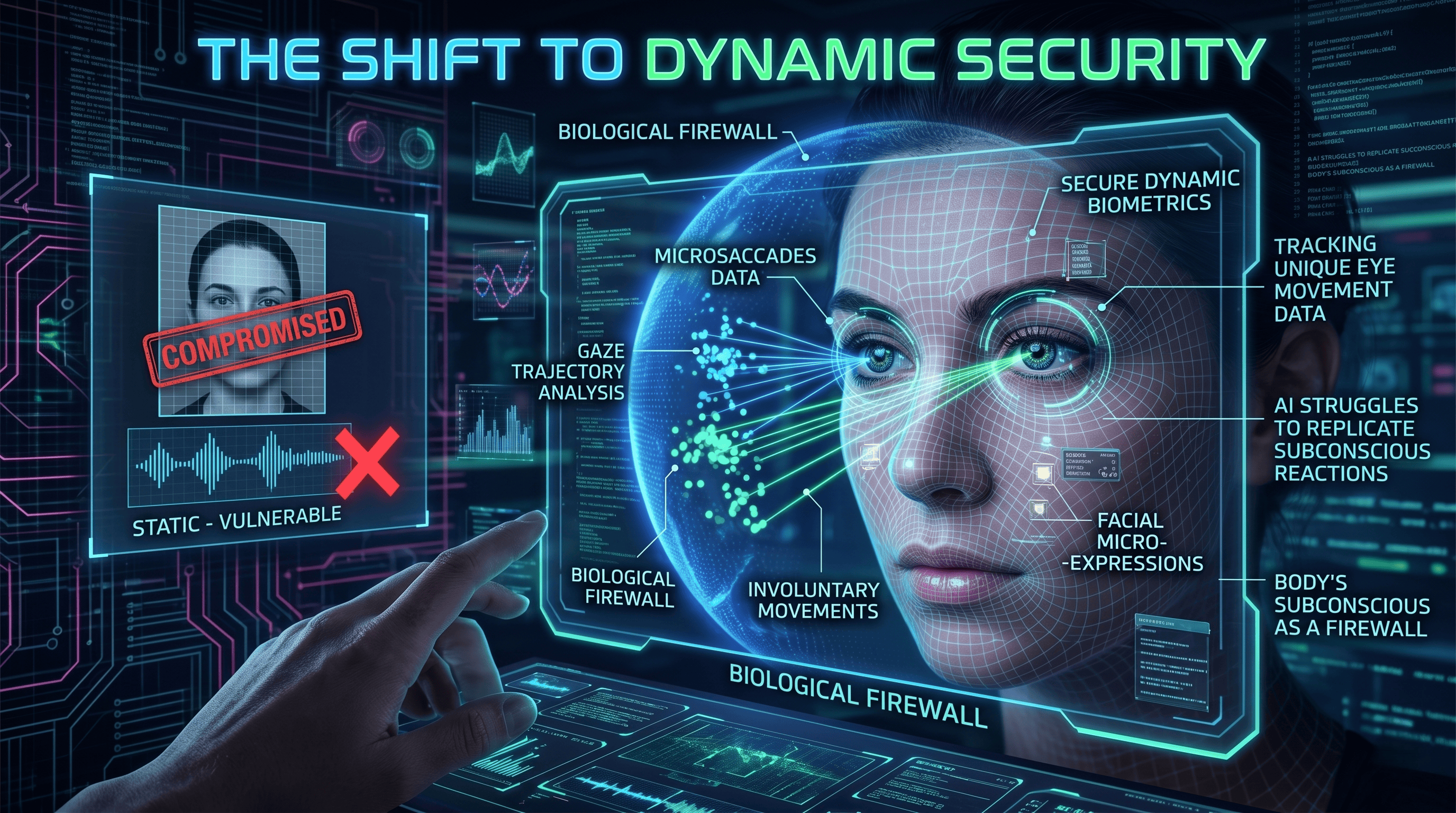
The critical insight is that these signals can't be consciously controlled or replicated from recorded data. As one expert noted: "Unlike facial authentication, where users can be tricked into altering their actions, micro eye movements cannot be consciously controlled. Replay attacks are ineffective because previously captured eye movement data cannot be reused."
The tradeoff: these dynamic biometrics require more sophisticated sensor hardware and take longer to authenticate, which creates usability friction. Authentication time is a practical bottleneck — as one researcher put it, "if gaze data takes minutes to authenticate, it's not realistic for everyday use."
The Tri-Layer Mitigation Framework
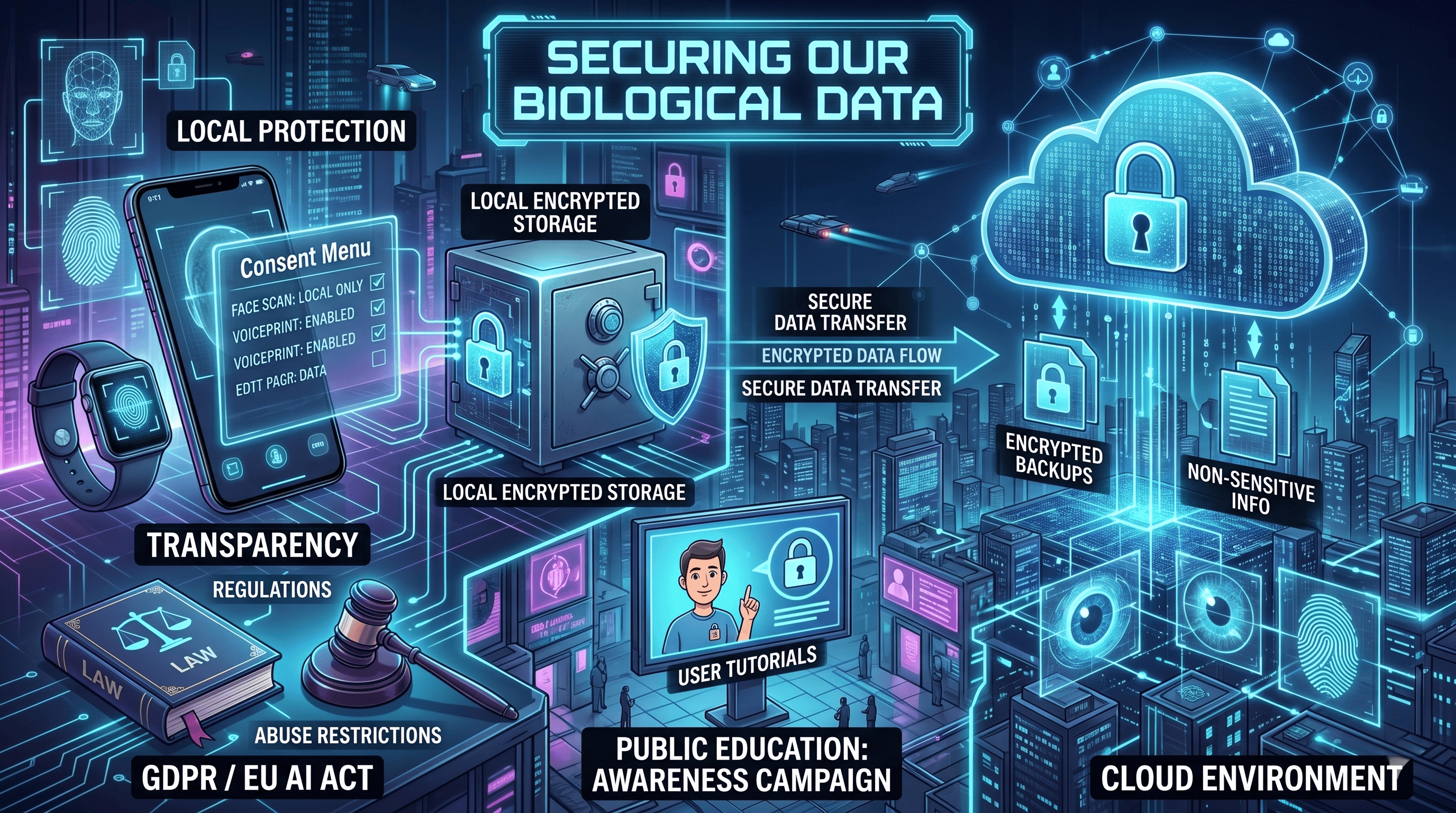
The study proposes defenses across three layers:
Technical Layer
- Transition from static to dynamic biometric signals (eye movement, micro-expressions)
- Deploy multi-factor authentication that combines biometrics with hardware tokens
- Implement continuous authentication — monitoring behavioral patterns throughout a session, not just at login
- Use adversarial training to harden detection models against manipulation
Social Layer
- Clear, plain-language consent interfaces for biometric data collection (not buried in legal jargon)
- Targeted public education — especially for mid-career professionals in government and healthcare, who the study found had the lowest AI familiarity
- Digital literacy programs in schools to build awareness from an early age
Legal & Regulatory Layer
- Stronger enforcement under frameworks like GDPR and the EU AI Act
- Substantial penalties for inadequate biometric data protection
- International cooperation on cross-border biometric data standards
- Specific legal protections against non-consensual deepfake content
For a deeper look at how detection, disruption, and authentication work together as defense layers, read: How to Spot AI-Generated Images: Artifacts, Detection Methods & Defenses.
What the Survey Numbers Tell Us
The study's quantitative findings paint a revealing picture of how people actually use and perceive biometrics:
- 51% of respondents use biometric authentication multiple times per day
- 88% use biometrics for banking and financial services
- 75% have used fingerprint authentication; 67.6% have used facial recognition
- Less than 1% have used vein authentication
- Finance professionals showed the highest skepticism about biometric security — suggesting that proximity to financial fraud creates more realistic risk assessment
- Younger, recently educated professionals (especially in tech and academia) had significantly higher AI familiarity, while mid-career managers showed the lowest
- Academia was notably more critical of current biometric security practices than all other sectors
The gap that matters most: public participants generally trusted biometrics for convenience, but exhibited limited understanding of deepfake risks. Most couldn't articulate how a deepfake could bypass their phone's face unlock — while every expert in the study could describe multiple attack vectors in detail.
What You Can Do Right Now
- Don't rely on face unlock alone for sensitive accounts. Enable multi-factor authentication — biometrics + a strong password or hardware security key (FIDO2/WebAuthn) — for banking, email, and cloud storage.
- Audit your public media footprint. Every photo, video, and voice recording you post gives generative AI potential training data. Be selective about what stays public.
- Verify suspicious media before acting on it. If you receive a video call, image, or voice message that seems off — pause. Run images through an AI image detector to check for generation artifacts.
- Keep your devices updated. Manufacturers continuously refine liveness detection algorithms to counter new spoofing techniques.
- Push for transparency. When apps ask for biometric data, understand what's being stored and where. Prefer systems that keep biometric templates on-device (like Face ID's Secure Enclave) rather than in the cloud.
The Bottom Line
Biometric authentication was built on the assumption that your face is uniquely yours. Deepfakes are challenging that assumption in practice — and the research shows that public awareness is dangerously behind where it needs to be.
The shift toward dynamic biometrics is coming. Your next phone unlock might take a fraction of a second longer, as the system checks not just who you are but how your eyes move while looking at the screen. Understanding why that change is happening is the first step toward staying ahead of biometric fraud.
Frequently Asked Questions
Can deepfakes actually bypass Apple Face ID?
Apple's Face ID uses 3D depth mapping (TrueDepth camera), which makes it significantly harder to spoof than 2D camera-based systems. However, digital injection attacks — which bypass the camera entirely by injecting synthetic video into the device's data stream — can potentially circumvent even depth-sensing systems. The research shows that static biometrics like face photos are fundamentally more vulnerable than dynamic biometrics like eye movement patterns.
How much training data does someone need to create a deepfake of me?
Alarmingly little. Your Instagram selfies, a 30-second voice clip, and any Zoom recording are enough to train a generative model. Consumer-grade apps like DeepFaceLive and SaaS platforms like D-ID have reduced the barrier from state-level capability to a consumer product.
What is the Deepfake Kill Chain?
Adapted from Lockheed Martin's cybersecurity kill chain, the Deepfake Kill Chain maps how biometric attacks progress: Reconnaissance (harvesting public media), Weaponization (training a generative model), Delivery (presenting the fake to an auth system), Exploitation (system accepts it), and C2 (attacker establishes persistent access). Each phase offers different defense opportunities.
Which biometrics are hardest for AI to fake?
Dynamic biometrics — signals your body produces unconsciously — are the hardest to replicate. These include microsaccades (tiny involuntary eye movements), gaze trajectories (how your eyes scan a screen), and facial micro-expressions. Unlike a face photo or voiceprint, these can't be consciously controlled or reproduced from recorded data.
Worried about a deepfake? Check suspicious images in seconds — isthisaiphoto.com is free, private, and works on images from any AI model. No signup required.
Related Reading
- How to Detect AI-Generated Images: 5 Checks Anyone Can Do — Practical guide to spotting AI-generated photos with visual checks and free tools.
- How to Spot AI-Generated Images: Artifacts, Detection Methods & Defenses — The research deep dive into detection, disruption, and authentication defenses.
- Can AI Detectors Catch OpenAI's Latest Images? We Tested It — Real-world detection test results against the newest AI generators.