AI-Generated Images Are Fueling Online Scams: E-Commerce, Insurance & Identity Fraud (2026)

You find a product on Amazon. The listing shows a sleek, well-lit photo of exactly what you've been looking for — the right color, the right angle, professional-quality lighting. You order it. Two weeks later, what arrives looks nothing like the photo. The shape is off, the color is wrong, and the quality is a fraction of what was shown.
That product photo? It was never taken by a camera. An AI generated it from a text prompt, polished it to look like a studio shot, and uploaded it as a listing image. You just got scammed by a picture.
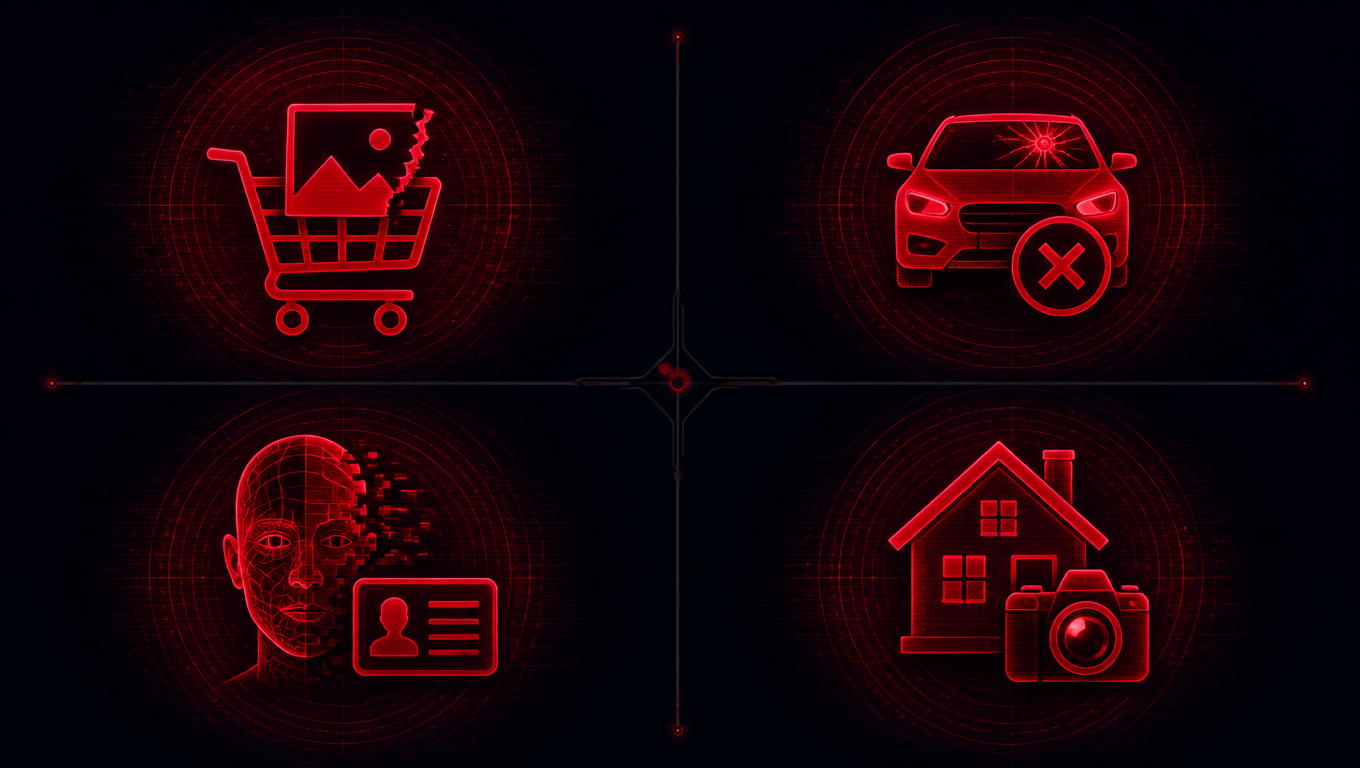
This isn't a one-off. Across e-commerce, insurance, real estate, and identity verification, AI-generated images are becoming a tool of choice for fraudsters — and the financial impact is staggering.
E-Commerce: When the Product Photo Doesn't Exist
Online shopping has always had a trust problem. You can't touch the product, try it on, or inspect the quality. You rely on photos. But what happens when those photos are generated by AI — depicting products that either don't exist or look nothing like what will actually be shipped?
The Fake Product Image Pipeline
The playbook is straightforward:
- Generate a product image using an AI tool — a handbag, a pair of sneakers, a piece of furniture — with idealized lighting, perfect angles, and appealing colors.
- List it on a marketplace (Amazon, eBay, AliExpress, or a standalone Shopify store) with the AI-generated image as the primary product photo.
- Collect orders and payments before buyers receive the actual product — which is invariably lower quality, different in appearance, or entirely different from what was shown.
- Absorb the returns or shut down the store and create a new one. The economics often work even with high return rates, because the cost of AI generation is near zero.
This isn't theoretical. Marketplace regulators and consumer protection agencies have noted a sharp increase in product listings using images that were never captured by a camera. The cost barrier to entry has collapsed — generating a convincing product photo with a tool like Midjourney or Flux costs pennies and takes seconds.
Why Traditional Fraud Detection Misses It
Marketplace fraud detection systems were designed for a different era. They check for stolen images (reverse image search), flag known counterfeit sellers, and analyze review patterns. But an AI-generated product image is unique — it doesn't match any existing image in any database. Reverse image search returns nothing. The image looks professionally shot. It passes visual inspection by both automated systems and human moderators.
The result: a new category of fraud that existing detection pipelines weren't built to catch.
What's Being Done
The C2PA standard is beginning to address this. Amazon is piloting C2PA-based verification for product photos — a Content Credential on a listing image would prove it was captured by a real camera at a real location, not generated by AI (The Verge, 2024). Other major marketplaces are exploring similar approaches. But adoption is still in early stages, and most marketplace listings carry no provenance data.
For consumers, the practical defense is a combination of skepticism (if the price seems too good, it probably is), review analysis (look for reviews with real customer photos, not just text), and running the listing image through an AI detector.
Quick check: Before buying from an unfamiliar seller, drop the product photo into isthisaiphoto.com. Our detector analyzes the image for AI-generation signatures across multiple engines. Free, instant, no signup.
Insurance Fraud: AI-Generated Damage Photos
Insurance fraud is a $308 billion problem in the United States alone, costing the average American family between $400 and $700 per year in increased premiums (Coalition Against Insurance Fraud, 2024). AI-generated images are making it worse.
The Scam
The pattern is simple: file an insurance claim for property damage, vehicle damage, or personal injury — and submit AI-generated photos as evidence.
-
A policyholder claims their car was damaged in a parking lot and submits photos of a dented, scratched vehicle that was never actually in an accident. The images are generated by AI to look like casual smartphone photos — slightly blurry, realistic lighting, even simulated EXIF data.
-
A homeowner claims storm damage to their roof and submits AI-generated images of missing shingles and water damage. The "damage" was never real.
-
A health insurance claim includes AI-generated images of injuries or medical conditions.
These claims aren't caught by traditional fraud detection, which examines the claim narrative for inconsistencies but rarely questions whether the photographic evidence itself is authentic.
The Insurance Industry's Response
The insurance industry is moving faster than most on this problem. Truepic, a verification technology company, has partnered with multiple insurers to deploy C2PA-based photo verification in the claims process.
The approach works like this: when a policyholder needs to document damage, they use a verified app that captures photos with embedded C2PA metadata — recording the exact time, GPS location, and device used. The insurer can verify the provenance chain before processing the claim.
Industry estimates suggest that AI-assisted fraud could cost the insurance sector $5 to $15 billion annually if left unchecked (Truepic, 2025). The investment in provenance verification is a fraction of that potential loss.
But there's a gap: verified apps only work for new claims going forward. The existing pipeline of claims submitted with unverified smartphone photos remains vulnerable. And not all policyholders will use a verification app voluntarily — which is why some insurers are beginning to require it for claims above certain thresholds.
Identity and KYC Fraud: AI Faces for Fake People
"Know Your Customer" (KYC) processes — the identity verification you go through when opening a bank account, applying for a loan, or signing up for a financial platform — typically require a government ID photo and a live selfie. The system compares the two to verify you are who you claim to be.
AI-generated faces are now being used to bypass these systems.
How It Works
- A fraudster obtains or generates a high-quality AI face — realistic enough to pass visual inspection.
- They create a fake government ID using the AI-generated face, or pair a stolen ID with an AI-generated selfie that matches the ID photo.
- They submit the documents through the KYC process, which compares the selfie to the ID photo. If the AI face is convincing enough, it passes.
- The fraudster now has a verified bank account under a fake identity — ready for money laundering, loan fraud, or other financial crimes.
This is a direct extension of the deepfake technology discussed in our earlier articles on biometric security — but applied specifically to financial fraud rather than phone unlocking.
The Scale of the Problem
The FBI's Internet Crime Complaint Center (IC3) reported over $12.5 billion in losses from internet-enabled crime in 2023, with business email compromise, investment fraud, and identity theft among the top categories (FBI IC3, 2023). AI-generated identities amplify all three.
Financial institutions are responding with liveness detection — requiring users to perform specific actions (blink, turn their head, read a phrase) during the selfie step. But generative AI is closing this gap too. Real-time deepfake video that can respond to random prompts is already demonstrated in research labs and will soon be commercially available.
The arms race between identity verification and AI-generated identity is accelerating, and current solutions are running behind.
Real Estate: AI-Staged Listings
Real estate fraud has a new dimension. Traditional listing manipulation involved wide-angle lenses and strategic photography to make rooms look larger. AI takes it further:
- Virtual staging on steroids: AI generates entirely new interior designs, furniture arrangements, and even structural features that don't exist in the actual property.
- Condition fabrication: AI images show a renovated kitchen, updated bathroom, or finished basement — when the actual property has none of these.
- Neighborhood manipulation: AI-generated images place the property in a more appealing context — better weather, greener landscaping, cleaner streets.
Zillow and Realtor.com are piloting C2PA verification for listing photos, aiming to verify that photos were actually taken at the listed property during the listing period. But again, this is early-stage, and the vast majority of listings carry no provenance data.
For buyers, the rule remains: don't trust listing photos at face value. Visit in person, request video walkthroughs, and verify that the photos match the property's public records and tax assessment images.
The Common Thread: AI Removes the Cost Barrier
What connects e-commerce fraud, fake insurance claims, identity fabrication, and listing manipulation? A single economic shift: the cost of producing convincing photographic "evidence" has dropped to nearly zero.
Before generative AI, fabricating a convincing product photo required photography equipment, studio setup, or at minimum, skilled Photoshop work. Creating a fake identity photo required face-swapping expertise. Generating fake damage photos required either staging actual damage or advanced image editing skills.
Now, anyone with access to a generative AI model and a text prompt can produce images that are indistinguishable from real photographs to most viewers and many automated systems.
This isn't a problem that will be solved by telling people to "be more careful." The images are too good, the volume is too high, and the cost is too low. What's needed is a combination of:
- Provenance technology (C2PA, watermarks) — making it possible to verify that an image was captured by a real camera in a real context
- Detection tools — analyzing images for AI-generation signatures when provenance data is absent
- Regulatory frameworks — the EU AI Act's disclosure requirements set a baseline; more jurisdictions need to follow
- Platform enforcement — marketplaces, insurers, and financial institutions requiring verification for high-stakes image submissions
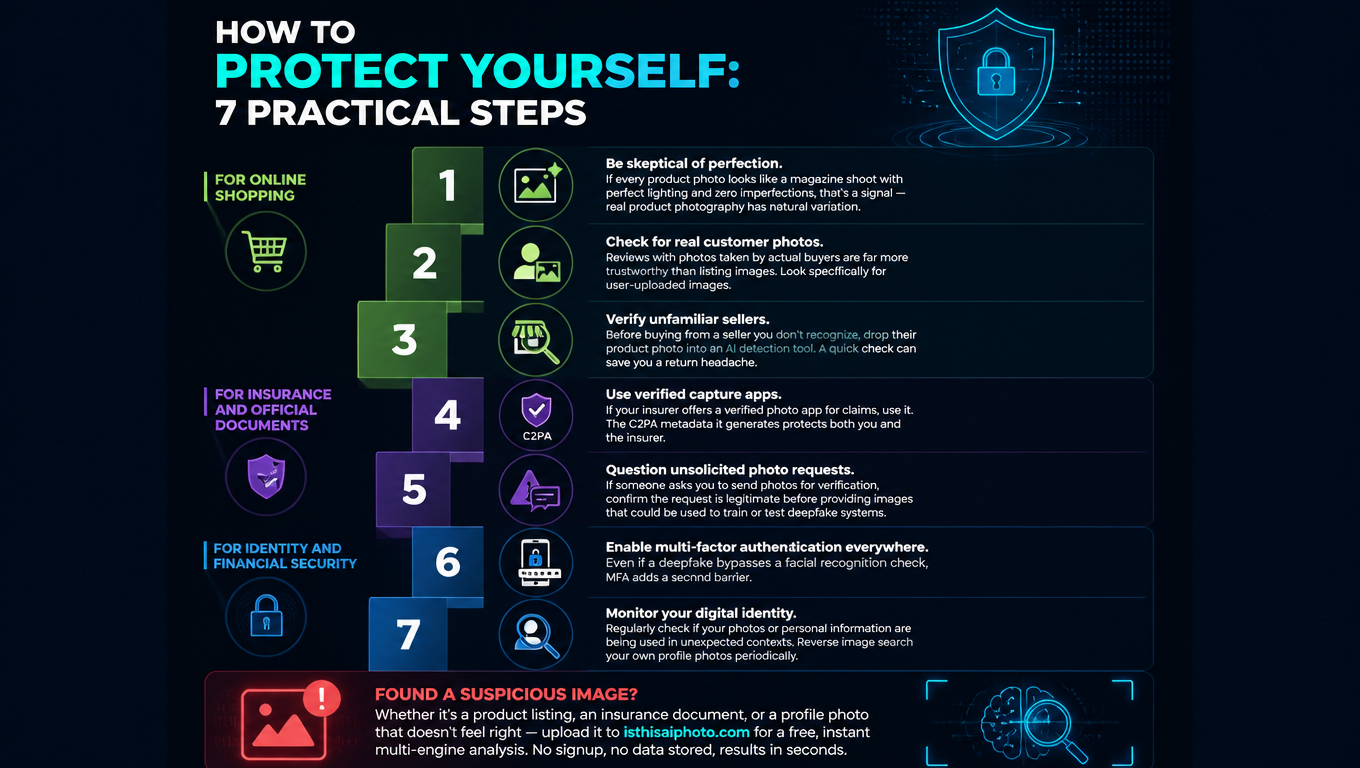
How to Protect Yourself: 7 Practical Steps
For Online Shopping
- Be skeptical of perfection. If every product photo looks like a magazine shoot with perfect lighting and zero imperfections, that's a signal — real product photography has natural variation.
- Check for real customer photos. Reviews with photos taken by actual buyers are far more trustworthy than listing images. Look specifically for user-uploaded images.
- Verify unfamiliar sellers. Before buying from a seller you don't recognize, drop their product photo into an AI detection tool. A quick check can save you a return headache.
For Insurance and Official Documents
- Use verified capture apps. If your insurer offers a verified photo app for claims, use it. The C2PA metadata it generates protects both you and the insurer.
- Question unsolicited photo requests. If someone asks you to send photos for verification, confirm the request is legitimate before providing images that could be used to train or test deepfake systems.
For Identity and Financial Security
- Enable multi-factor authentication everywhere. Even if a deepfake bypasses a facial recognition check, MFA adds a second barrier.
- Monitor your digital identity. Regularly check if your photos or personal information are being used in unexpected contexts. Reverse image search your own profile photos periodically.
Found a suspicious image? Whether it's a product listing, an insurance document, or a profile photo that doesn't feel right — upload it to isthisaiphoto.com for a free, instant multi-engine analysis. No signup, no data stored, results in seconds.
References
- Coalition Against Insurance Fraud. The Impact of Insurance Fraud in America. Coalition Against Insurance Fraud, 2024. — Estimates U.S. insurance fraud costs at $308 billion annually.
- FBI Internet Crime Complaint Center (IC3). 2023 Internet Crime Report. FBI IC3, 2023. — Reports $12.5 billion in internet-enabled crime losses, with identity theft and financial fraud among top categories.
- Truepic. Content Provenance for Insurance Claims Verification. Truepic, 2025. — Deploys C2PA-based photo verification in insurance claims processes; estimates $5-15B annual risk from AI-assisted fraud.
- The Verge. "Amazon adopts C2PA content credentials for product images." The Verge, September 2024. — Amazon's C2PA pilot for marketplace product photo verification.
- C2PA / Eyesift. "C2PA Content Credentials 2026 Adoption Guide." Eyesift.com, April 2026. — Tracks C2PA adoption across 15 major organizations including e-commerce and real estate use cases.
- European Parliament and Council. Regulation (EU) 2024/1689 — Artificial Intelligence Act. Official Journal of the EU, 2024. — Article 50 mandates disclosure of AI-generated synthetic content.
- Reuters. "AI deepfakes blur reality in 2026 US midterm campaigns." Reuters, March 28, 2026. — Documents the rapid improvement in AI-generated image quality and its implications for trust.
Related Reading
- How to Tell If a Dating Profile Photo Is AI-Generated — The consumer guide to spotting AI in romance scams — a related fraud pattern with different stakes.
- How to Detect AI-Generated Images: 5 Checks Anyone Can Do — The foundational visual detection guide for any AI-generated image.
- Content Credentials Explained: How C2PA and Watermarking Are Fighting AI Fakes — The deeper dive into the provenance infrastructure that's fighting back against AI fraud.