Content Credentials Explained: How C2PA and Watermarking Are Fighting AI Fakes in 2026
You see a photo of a news event. It looks real — natural lighting, believable context, no obvious artifacts. You run it through an AI detector and the result comes back "likely real." But "likely" isn't "definitely." How do you actually know?
For years, the answer has been to look for signs of fakery — check the hands, examine the shadows, analyze the frequency spectrum. That's detection: trying to find what's wrong with an image. But there's a fundamentally different approach that's now gaining real traction: instead of asking "is this fake?", ask "where did this come from?"
That's the idea behind Content Credentials — and in 2026, the infrastructure behind them is finally becoming real.
What Are Content Credentials?
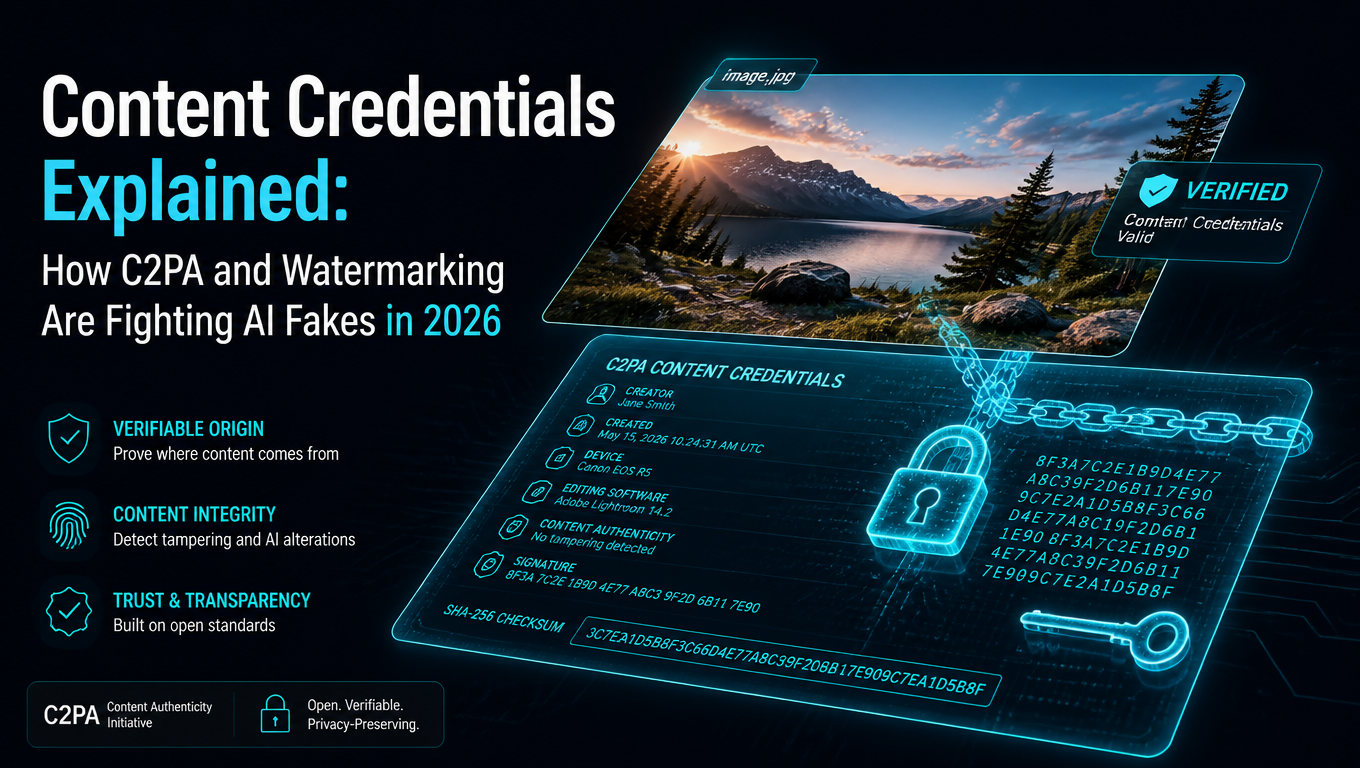
Think of Content Credentials as a digital nutrition label for images. Just as a food label tells you what's in your meal and where the ingredients came from, a Content Credential tells you who created an image, what tool was used, and whether it was modified or AI-generated.
Technically, Content Credentials are based on the C2PA standard (Coalition for Content Provenance and Authenticity) — an open specification maintained by an industry consortium that includes Adobe, Microsoft, Google, Intel, BBC, and others. The current version is C2PA 2.3, released in January 2026.
Here's how it works in plain terms:
-
At creation — When a photo is taken with a C2PA-enabled camera, or an image is generated with a C2PA-compliant AI tool, a cryptographic manifest is attached to the file. This manifest records the origin, creation tool, timestamp, and — if applicable — the fact that AI was involved.
-
During editing — As the image passes through compatible editing software (like Adobe Photoshop), each edit is logged in the manifest. You end up with a tamper-evident chain of custody — a complete edit history sealed with cryptographic signatures.
-
At verification — When you view the image, a compatible viewer or website can read the manifest and display the provenance chain. You see: who made it, what tool was used, whether AI was involved, and what edits were made.
The key insight is that the metadata travels with the image. It's embedded in the file itself, not stored on a separate server that could be taken down or manipulated.
Who's Adopting C2PA in 2026?
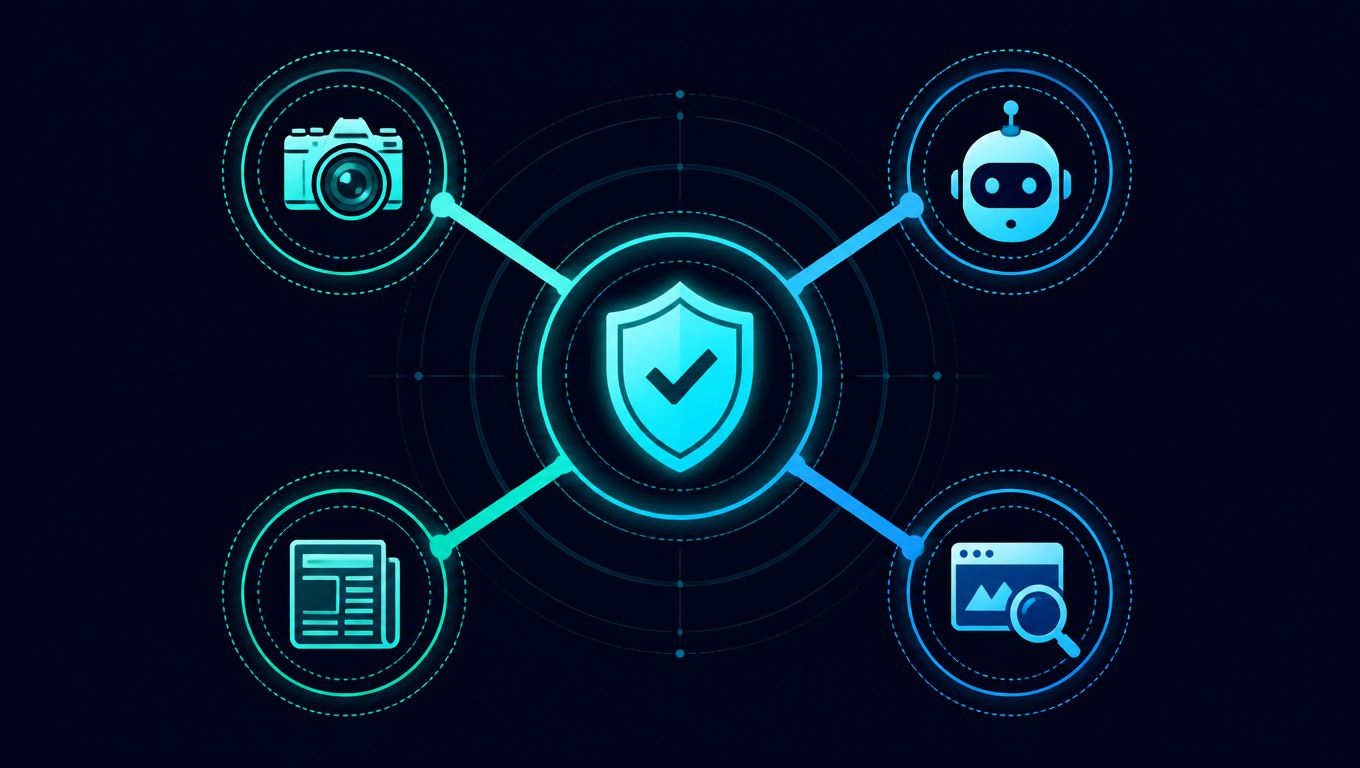
This isn't a theoretical standard gathering dust in a specification document. As of early 2026, 15 major organizations have shipped or are actively deploying C2PA support.
Camera Makers — Signing at the Source
The most important adopters are camera manufacturers, because provenance starts at the moment of capture.
-
Sony was first. The Alpha 1, α1 II, and α7 IV cameras ship with native C2PA firmware. When a photojournalist snaps a picture, the camera embeds a cryptographic signature directly into the image file — proving it was taken by that specific camera at that specific time and location.
-
Canon followed with the EOS R5C, R5 Mark II, and R6 Mark II, all supporting C2PA natively since late 2024.
-
Nikon added support in the Z9 and Z8, targeting sports and news photographers.
This matters because a photo signed by a camera has a fundamentally different trust level than one uploaded without provenance. When Reuters or the BBC publishes a C2PA-signed photo, you can verify the entire chain: camera → photographer → newsroom → publication.
AI Generation Tools — Disclosing Synthetic Origins
On the other side of the spectrum, AI generation tools are adopting C2PA to clearly mark content as AI-generated.
-
OpenAI integrated optional C2PA signing into DALL-E 3 and GPT-4o image generation. When a user opts in, the generated image carries a manifest identifying it as AI-generated content.
-
Adobe Firefly signs all generated images by default through the Content Credentials panel in Photoshop and Firefly.
This is the dual power of C2PA: the absence of a provenance chain becomes a signal too. If an image has no Content Credential at all, that's worth noting — especially for content claiming to be documentary.
Newsrooms — The Trust Chain
Major news organizations are deploying C2PA in their production workflows:
- BBC News — All BBC News images are C2PA-signed through their production pipeline, as part of the Project Origin initiative.
- New York Times — Piloted C2PA for breaking news photos in 2024-2025, moving to production in 2026.
- Reuters — AP wire photos carry C2PA signatures for member newsrooms, ensuring that a photo published by a local newspaper in Ohio has the same verifiable provenance as one published by Reuters directly.
For journalism, this is transformative. In a world where "pics or it didn't happen" has been replaced by "pics might be fake," C2PA gives newsrooms a way to prove their photos are authentic without asking readers to take it on faith.
Search Engines and Social Platforms
-
Google Image Search began piloting Content Credentials badges in Q1 2026, displaying a small "CR" indicator on images that carry C2PA manifests. Google has signaled that content provenance may become a trust signal for search ranking in the future.
-
TikTok and YouTube have implemented AI-content disclosure requirements (separate from full C2PA but aligned in goal). Content creators must label AI-generated or synthetically altered content.
-
Meta rolled out AI-detection labels across Facebook and Instagram in 2024, with full C2PA integration pending.
How to check: Visit contentcredentials.org to verify any image's Content Credentials. Or simply upload suspicious images to isthisaiphoto.com — our detector analyzes the image itself when provenance data isn't available.
The EU AI Act: Watermarking Becomes Mandatory
The regulatory landscape shifted significantly when the EU AI Act began phased enforcement in 2025, with the most relevant provisions taking effect in 2026.
Article 50 of the EU AI Act requires that providers of AI systems generating synthetic content — images, audio, video, or text — must ensure their outputs are marked in a machine-readable way as artificially generated or manipulated (EU AI Act, 2024).
The primary obligation falls on AI providers — companies like OpenAI, Midjourney, and Stability AI. But the ripple effects reach everyone:
-
For AI companies: Non-compliance with the AI Act's disclosure requirements carries fines of up to 3% of global annual revenue (or €15 million, whichever is higher). Violations of the Act's prohibited practices — like deploying AI systems that manipulate human behavior — can trigger fines up to 7%. For major AI providers, that's a board-level risk.
-
For platforms: The EU AI Act creates a legal framework requiring platforms to detect and label AI-generated content, which accelerates C2PA adoption.
-
For creators: If you're a photographer or journalist, proactive watermarking of your human-created content becomes a way to differentiate authentic work from synthetic content. Your embedded watermark provides evidence of prior creation and ownership — useful if someone uses your photo to train an AI model, or if an AI-generated image closely resembles your work.
This regulation is the single biggest accelerant for content provenance adoption. When compliance carries financial consequences, adoption moves from "nice to have" to "board-level priority."
C2PA and Watermarking: Complementary, Not Competing
A common point of confusion: aren't C2PA and watermarking the same thing? They're not. They solve related problems in different ways.
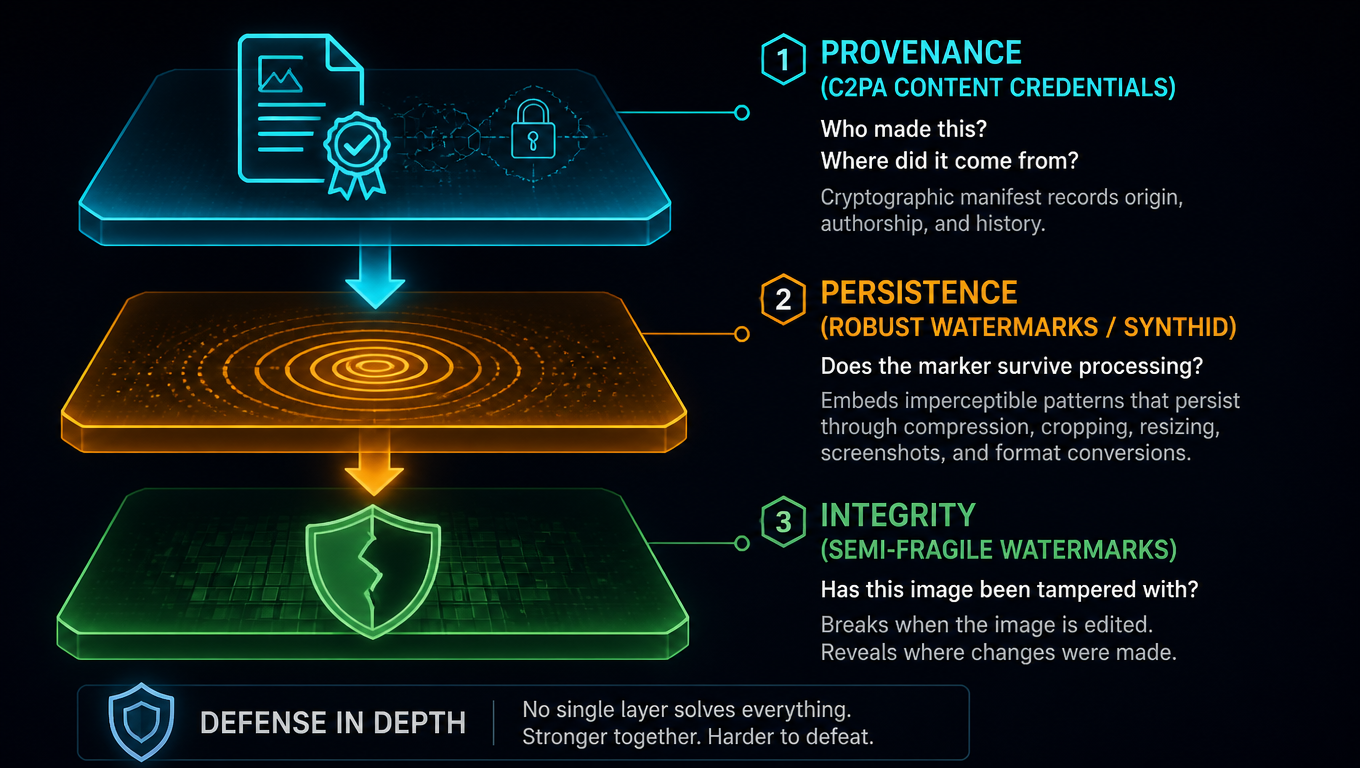
C2PA Content Credentials are about provenance — where did this image come from, who made it, and what happened to it along the way? The cryptographic manifest is attached to the file but can be stripped if the image is converted, screenshotted, or processed through non-compliant tools.
Watermarking is about survivability — embedding information that persists even when an image is compressed, cropped, or edited. There are two main types:
-
Robust watermarks survive heavy processing. They're designed to persist through compression, resizing, and even partial re-generation. Google's SynthID is the most prominent example — it embeds imperceptible patterns into AI-generated images that survive screenshots and format conversions.
-
Semi-fragile watermarks break when the image is tampered with. They're useful for detecting manipulation — if you apply a semi-fragile watermark to a photo and someone edits it, the watermark degrades in the edited regions, revealing where changes were made.
The ideal defense combines both:
| Layer | Technology | Purpose | |-------|-----------|---------| | Provenance | C2PA Content Credentials | Who made this? Where did it come from? | | Persistence | Robust watermarks (SynthID) | Does the marker survive processing? | | Integrity | Semi-fragile watermarks | Has this image been tampered with? |
No single layer solves everything. C2PA can be stripped. Watermarks can sometimes be removed. But together, they create a defense in depth — the same principle that underlies good cybersecurity.
Limitations: What C2PA Can't Do
We believe in transparency about what works and what doesn't. Here are the real limitations:
Old images don't have it. C2PA adoption started in 2021-2024. The billions of images already on the internet have no provenance data. You can't retroactively add credentials to a photo taken in 2019.
Screenshots strip it. If someone screenshots an image instead of downloading it, the C2PA manifest is lost. This is a fundamental limitation of the file-embedding approach.
Adoption is still early. While 15 major organizations have adopted C2PA, the vast majority of images online still carry no credentials. A missing credential doesn't mean an image is fake — it means you don't have provenance data, which is the current norm.
It doesn't detect fakes directly. C2PA proves authenticity, not fakeness. If an image has a valid C2PA chain from a trusted camera and newsroom, you can trust it. But if an image has no C2PA data, you're back to detection tools and critical thinking.
Malicious actors can sign fake content. A bad actor with access to a C2PA-enabled camera could photograph a staged scene and the resulting image would carry valid provenance — it's authentically captured, but the scene itself is manufactured.
This is why C2PA is best understood as one layer in a multi-layer defense, not a silver bullet. Detection tools like ours complement C2PA by analyzing the image content itself when provenance data is absent or insufficient.
The 2026 Outlook: Where This Is Heading
The convergence of regulation, industry adoption, and public awareness is creating real momentum:
Google's trust signal play. If Google begins factoring C2PA presence into search ranking — which they've signaled is under consideration — content creators and newsrooms will have a strong economic incentive to adopt provenance signing. SEO meets authenticity.
Camera-to-publication pipelines. The BBC, NYT, and Reuters are already running end-to-end C2PA chains. As more newsrooms adopt this, the gap between "signed" and "unsigned" journalism will widen. Readers will learn to look for the credential.
Consumer awareness. The EU AI Act's disclosure requirements mean that European consumers will increasingly encounter AI-content labels. As awareness grows, the absence of provenance data on "real-looking" content will become a red flag in itself.
Enterprise adoption. Beyond journalism and social media, industries like insurance, real estate, and e-commerce are beginning to explore C2PA for fraud prevention — verifying that damage photos, property images, and product shots are authentic.
The technology is here. The regulation is here. The adoption is accelerating. The question for 2026 isn't whether content provenance will matter — it's how quickly the ecosystem will reach critical mass.
References
- Coalition for Content Provenance and Authenticity. C2PA Specification v2.3. C2PA, January 2026. — The latest version of the open standard for content provenance.
- European Parliament and Council. Regulation (EU) 2024/1689 — Artificial Intelligence Act. Official Journal of the EU, 2024. — Article 50 mandates machine-readable marking of AI-generated synthetic content.
- Eyesift. "C2PA Content Credentials 2026 — Cryptographic Provenance Adoption Guide." Eyesift.com, April 2026. — Comprehensive tracking of 15 major C2PA adopters and 8 use cases.
- AIWatermark Team. "AI Content Watermarking in 2026: EU AI Act, C2PA, and What Creators Need to Know." AIWatermark Blog, March 5, 2026. — Analysis of EU AI Act watermarking requirements and their impact on creators.
- Wikipedia. "Content Credentials." Wikipedia, 2026. — Overview of C2PA adoption by producers (Adobe, Google, Sony, Canon, Nikon) and publishers (LinkedIn, TikTok, YouTube).
- U.S. National Security Agency / CISA. "Content Credentials: Strengthening Multimedia Integrity in the Age of AI." NSA Cybersecurity Information Sheet, January 2025. — U.S. government guidance on content provenance technologies.
Related Reading
- How to Detect AI-Generated Images: 5 Checks Anyone Can Do — The foundational guide to visual AI detection when provenance data isn't available.
- How to Spot AI-Generated Images: Artifacts, Detection Methods & Defenses — The technical deep-dive into the detection side of the defense-in-depth model.
- Can AI Detectors Catch OpenAI's Latest Images? We Tested It — Our hands-on test of detection accuracy against the latest generation models.