How AI Deepfakes Are Disrupting the 2026 Elections — And How Voters Can Fight Back
In March 2026, a video surfaced showing a U.S. Senate candidate standing in front of an American flag, calmly agreeing that a specific demographic was "the greatest domestic terrorist threat in our country." It looked real. The lighting was right, the lip movements synced, the tone was convincing. There was just one problem — the candidate never said those words.
The video was an AI-generated deepfake, produced by the National Republican Senatorial Committee (NRSC) and deployed in the Texas Senate race. A tiny disclaimer reading "this video is AI-generated" sat in the lower-right corner, easy to miss. By the time fact-checkers weighed in, the clip had already been seen by millions (Reuters, 2026).
This is not a hypothetical scenario. This is the 2026 midterm election cycle — and deepfakes are already shaping it.
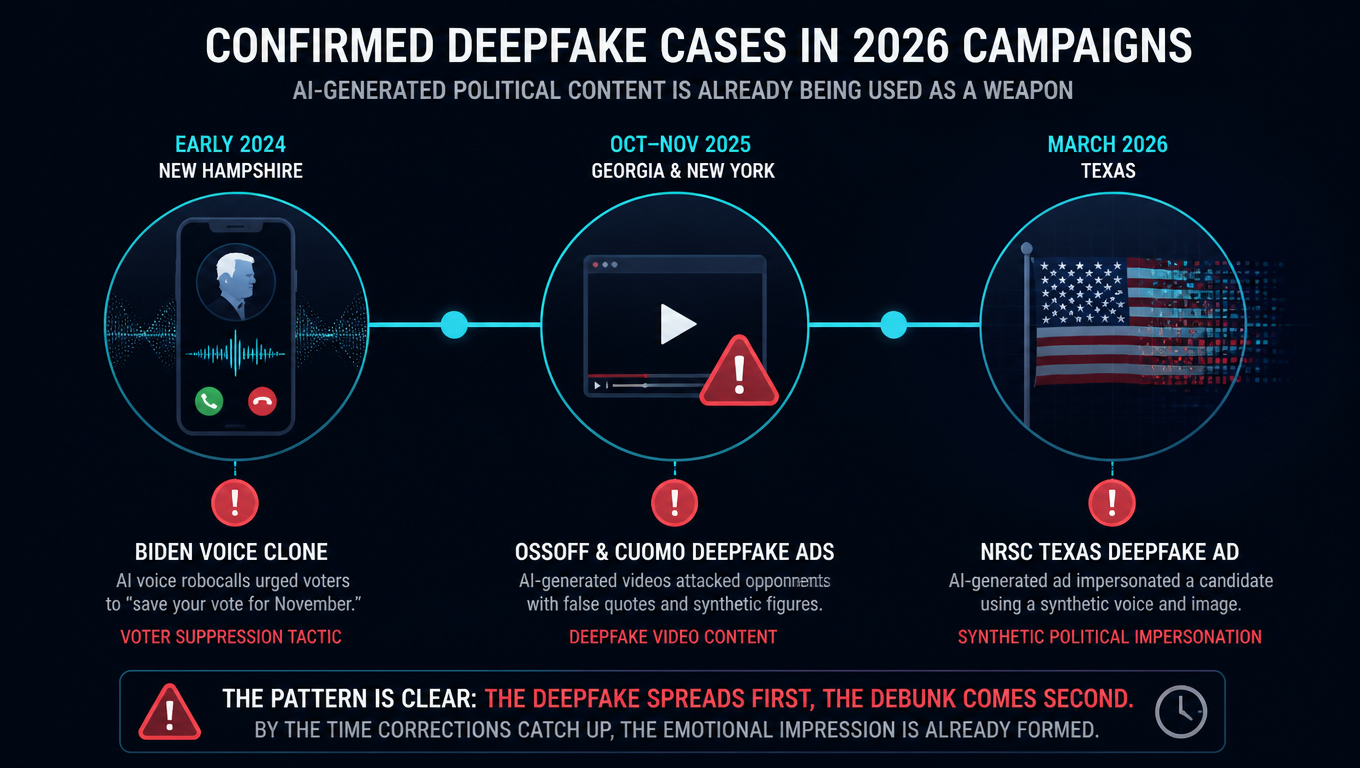
It's Already Happening — Confirmed Deepfake Cases in 2026 Campaigns
The Texas case isn't isolated. Across the country, AI-generated political content is being used as a campaign weapon — sometimes with small disclaimers, sometimes with none at all.
The Ossoff Deepfake (Georgia, November 2025) — Rep. Mike Collins' campaign released an AI-generated video of Senator Jon Ossoff in Georgia's Senate race. The deepfake showed a computer-generated Ossoff mocking farmers, claiming he'd "only seen a farm on Instagram" and defending a government shutdown. None of it was real (State of Surveillance, 2026). Collins' campaign added a barely visible disclaimer and continued running the ad.
The Cuomo Attack Ad (New York, October 2025) — During the NYC mayoral race, Andrew Cuomo's campaign posted an AI-generated attack ad titled "Criminals for Zohran Mamdani." The video featured AI-generated "criminals" — including a synthetic figure in stereotypical clothing — endorsing his opponent. The campaign deleted it within minutes and blamed a "junior staffer" (State of Surveillance, 2026).
The Biden Voice Clone (New Hampshire, 2024) — Before the 2024 primary, voters in New Hampshire received robocalls using an AI clone of President Biden's voice, urging them to "save your vote for November" — a textbook voter suppression tactic. The FCC subsequently ruled that AI voice clones count as "artificial or prerecorded voices" under the Telephone Consumer Protection Act, making such robocalls illegal without prior consent (FCC, 2024).
These cases share a pattern: the deepfake spreads first, the debunk comes second. By the time corrections catch up, the emotional impression is already formed.
Why "Just Look for the Tells" No Longer Works
A year or two ago, the standard advice was to check for visual artifacts — weird hands, uncanny eye movements, mismatched shadows, or glitchy backgrounds. That advice is increasingly outdated.
Modern AI generators — particularly diffusion-based models like those behind the latest Midjourney, DALL-E, and open-source Flux variants — have dramatically reduced the frequency-domain artifacts that older detectors relied on. The periodic spikes in high-frequency bands that once gave away AI images are being smoothed out by better upsampling pipelines.
Research has consistently shown that both human observers and automated detection tools struggle to reliably identify modern deepfakes. Looking for "tells" is like checking for Photoshopped images by looking for obvious clone-stamp edges — the technology has moved on.
Quick check: Don't trust your gut alone. Drop any suspicious political image or screenshot into our free AI image detector for an instant multi-engine analysis. No signup, no data stored — results in seconds.
This doesn't mean detection is useless. It means detection needs to be one layer in a larger defense — not the whole strategy.
The Legal Patchwork: 26 States Have Laws, Most Won't Stop Much
State legislatures have moved faster than Congress. From just 5 states with deepfake election laws in 2023, we're now at 26 states as of early 2026 (State of Surveillance, 2026):
Alabama, Arizona, California, Colorado, Delaware, Florida, Hawaii, Idaho, Indiana, Kentucky, Massachusetts, Michigan, Minnesota, Mississippi, Montana, Nevada, New Hampshire, New Mexico, New York, North Dakota, Oregon, Pennsylvania, Rhode Island, South Dakota, Texas, Utah, and Washington all have laws on the books. Five more — New Jersey, Virginia, Maryland, Tennessee, and Vermont — are actively considering bills.
But here's the catch: most of these laws only require disclosure, not bans. Stick a label on your deepfake — even a barely visible one — and you're technically compliant. That tiny "AI-generated" disclaimer in the corner of the NRSC's Texas ad? It was designed to meet disclosure requirements, not to inform viewers.
A few states go further:
- Texas prohibits deepfake videos intended to influence voters within 30 days of elections
- Maryland criminalizes AI deepfakes used for election misinformation under SB0141
- California tried to ban deceptive deepfakes outright — but a federal court struck it down as a First Amendment violation
That First Amendment wall is the constitutional reality other states keep hitting. The result is a patchwork of laws with wide variation in enforcement power.
The Federal Gap
While states scramble, the Federal Election Commission (FEC) has been effectively deadlocked. In August 2023, the FEC asked for public comments on AI in campaign ads. Since then? Interpretive guidance saying existing fraud laws apply "regardless of technology." No new rules. No specific requirements (State of Surveillance, 2026).
The FEC, working with DOJ and FTC, is reportedly drafting rules for AI content ethics and synthetic media — expected "by mid-2026." That timeline means the rules arrive after primaries are already underway and deepfakes have already circulated.
The FCC has done more. In February 2024, they ruled that AI-generated voice clones fall under the Telephone Consumer Protection Act, making deepfake robocalls illegal without prior consent. That was a direct response to the Biden voice clone incident in New Hampshire.
What Platforms Are Doing (And What They're Not)
Social media platforms have introduced various policies for AI-generated content, but enforcement remains inconsistent.
TikTok and YouTube both require disclosure when content is AI-generated, particularly for realistic depictions of public figures. TikTok introduced mandatory AI-content labels in 2024. YouTube requires creators to disclose AI-generated content that could be mistaken for real footage.
Meta (Facebook/Instagram) implemented AI-detection labels in 2024, but relies heavily on automated systems to flag content — the same automated systems that struggle to keep pace with new generation models.
The C2PA standard — which embeds cryptographic provenance data directly into image files — is emerging as the most robust solution. Google Image Search began piloting C2PA Content Credentials badges in Q1 2026, and major newsrooms (BBC, NYT, Reuters) now sign their photos with C2PA metadata. But adoption is still early, and most political content circulating on social media has no provenance data attached.
The fundamental problem: platforms can label content, but they can't un-ring the bell. A deepfake that reaches 2 million views before being flagged has already done its work. The emotional impact of seeing a candidate "say" something inflammatory doesn't evaporate when a small label appears.
What About AI Detection Tools?
Automated deepfake detection tools — including ours — play an important role, but it's important to understand both their strengths and their limits.
Modern AI image detectors use multiple analysis methods: frequency-domain analysis to spot periodic artifacts, noise pattern analysis to identify model-specific signatures, texture entropy measurements, and neural network classifiers trained on known generation architectures. These methods can catch a significant percentage of AI-generated images, including many political deepfakes.
But there are real limitations:
- Arms race dynamics: Detectors are trained on yesterday's deepfakes. New generation models can evade older detectors.
- Compression artifacts: Social media platforms compress images heavily, which can destroy the subtle signals that detectors rely on.
- Video vs. image: Most detection tools work on still images. Deepfake videos require frame-by-frame analysis, which is computationally expensive and less reliable.
- Adversarial attacks: Bad actors can intentionally add perturbations to deepfakes to fool detectors.
We don't claim our tool catches everything. What we do is give you a mathematical likelihood based on multiple independent analysis engines — more information than your eyes alone can provide.
Try it yourself: Found a suspicious campaign image or political meme? Upload it to isthisaiphoto.com for a free, instant analysis. Our multi-engine system checks frequency patterns, noise signatures, and structural consistency. No signup, no data stored.
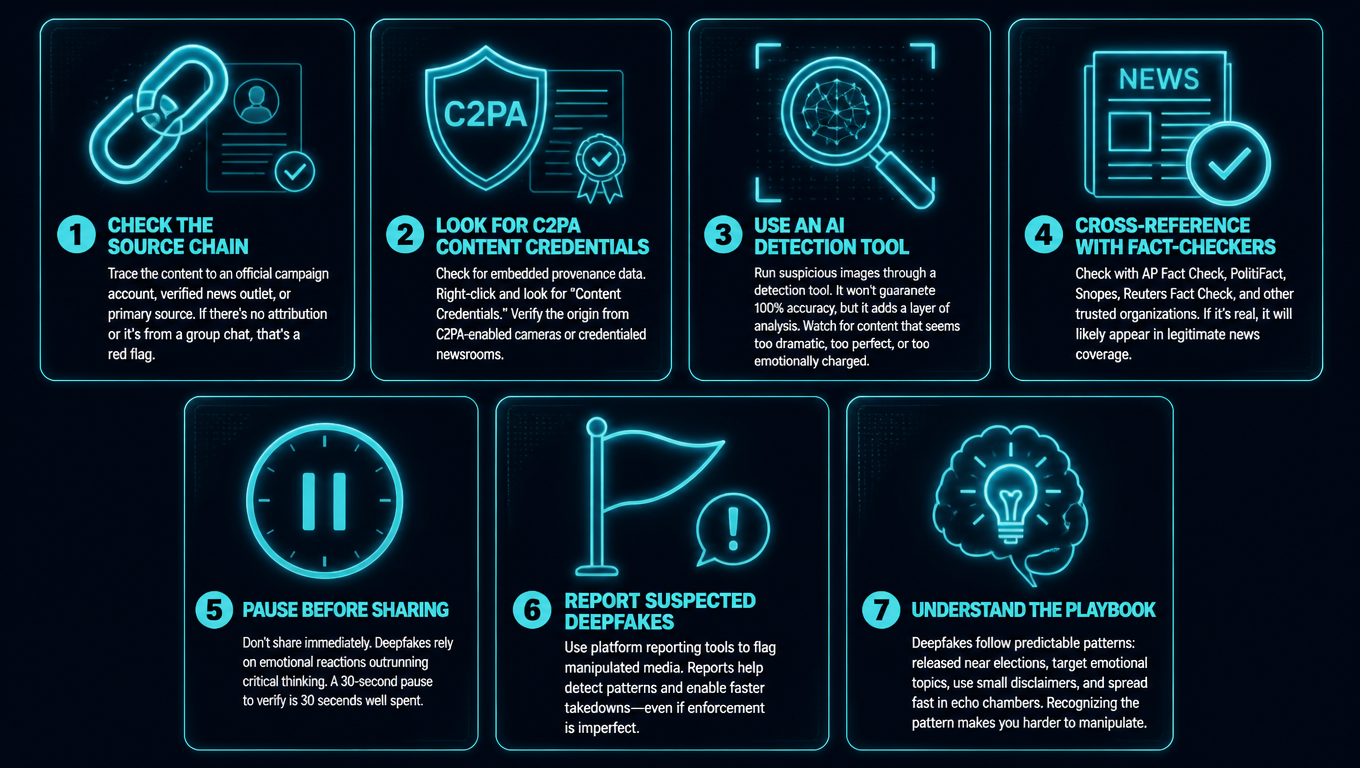
What Voters Can Actually Do: A Practical Checklist
Given that laws are weak, platforms are slow, and detection tools have limits, what can an individual voter do?
1. Check the Source Chain
Before reacting to a political image or video, ask: Where did this actually come from? Can you trace it to an official campaign account, a verified news outlet, or a primary source? If it's circulating in a group chat with no attribution, that's a red flag.
2. Look for C2PA Content Credentials
Some images now carry embedded provenance data. Right-click on an image and check if your browser or photo viewer shows a "Content Credentials" option. If the image was taken by a C2PA-enabled camera (Sony α1, Canon R5 II, Nikon Z9) or published by a credentialed newsroom (BBC, NYT, Reuters), you can verify its origin chain.
3. Use an AI Detection Tool
Run suspicious images through a detection tool like ours. It won't give you a 100% guarantee, but it adds a layer of analysis beyond your own judgment. Pay particular attention to images that seem too dramatic, too perfectly timed, or too emotionally charged.
4. Cross-Reference with Fact-Checkers
Organizations like AP Fact Check, PolitiFact, Snopes, and Reuters Fact Check actively monitor election-related deepfakes. If a viral political image is real, it will likely appear in legitimate news coverage. If it doesn't, be skeptical.
5. Pause Before Sharing
The single most effective action any voter can take is also the simplest: don't share immediately. Deepfakes rely on emotional reactions outrunning critical thinking. A 30-second pause to verify is 30 seconds well spent.
6. Report Suspected Deepfakes
Most platforms have reporting mechanisms for manipulated media. Using them helps — even if enforcement is imperfect, reports contribute to pattern detection and faster takedowns.
7. Understand the Playbook
Political deepfakes follow predictable patterns: they're released close to elections, they target emotionally charged topics, they use small disclaimers for legal cover, and they spread fastest in echo chambers. Recognizing the pattern makes you harder to manipulate.
The Bigger Picture: Detection Is Necessary But Not Sufficient
The fight against election deepfakes isn't a technology problem with a technology solution. It's a society-wide challenge that requires action on multiple fronts:
Technology — Better detection tools, wider adoption of C2PA content credentials, platform-side verification systems. This is where we focus our work.
Law — Stronger federal regulation, clearer rules for campaign use of AI, and enforcement mechanisms with real teeth. The current state-by-state patchwork leaves too many gaps.
Platform accountability — Faster detection and labeling of AI-generated political content, with meaningful consequences for campaigns that use deepfakes without clear disclosure.
Media literacy — Teaching voters to approach political content with healthy skepticism, verify before sharing, and understand how AI-generated media works.
No single tool or law will solve this. But together, these layers of defense can make it significantly harder for deepfakes to influence elections.
The 2026 midterms are a proving ground. The choices made now — by legislators, platforms, and voters — will shape how democratic processes handle synthetic media for decades to come.
References
- Reuters. "AI deepfakes blur reality in 2026 US midterm campaigns." Reuters, March 28, 2026. — Reports on NRSC's AI-generated political ad targeting Texas State Rep. James Talarico and the broader trend of deepfake campaign ads.
- State of Surveillance. "AI Deepfakes Are Flooding the 2026 Midterms. 26 States Scramble to Catch Up." State of Surveillance, 2026. — Comprehensive analysis of 26 state deepfake election laws, confirmed campaign deepfake cases, and FEC inaction.
- OECD AI Policy Observatory. "AI Deepfakes Used to Mislead Voters in 2026 US Midterm Campaigns." OECD.AI Incident Monitor, March 28, 2026. — OECD's formal classification of 2026 election deepfakes as an AI incident.
- FCC. "FCC Declaratory Ruling on AI-Generated Voices in Robocalls." Federal Communications Commission, February 2024. — Ruling that AI voice clones fall under the Telephone Consumer Protection Act.
- Associated Press. "AI-created election disinformation is deceiving the world." AP News, 2025. — Global survey of AI-generated election disinformation across multiple countries.
- Alan Turing Institute (CETAS). "From Deepfake Scams to Poisoned Chatbots: AI and Election Security in 2025." CETAS Publications, 2025. — Research on the intersection of AI-generated media and election security threats.
Related Reading
- How to Detect AI-Generated Images: 5 Checks Anyone Can Do — The beginner's guide to spotting AI images with visual checks and a free detector.
- Can Deepfakes Fool Face ID? How AI Is Breaking Facial Recognition — How deepfakes are bypassing biometric security systems and what you can do about it.
- How to Spot AI-Generated Images: Artifacts, Detection Methods & Defenses — The technical deep-dive into detection methods, disruption techniques, and authentication layers.